Imagine a familiar DeFi situation in Germany: you hold assets on Ethereum, use a lower-cost rollup for everyday swaps, and keep liquidity on a third network. A new protocol promises attractive returns, but the transaction request is a dense block of contract data. You can see the destination address and the gas estimate; you cannot easily see whether you are depositing tokens, granting a broad approval, or signing something that could move assets later. The practical risk is not merely choosing the wrong blockchain. It is authorising the wrong state change.
This is where a multi-chain wallet such as Rabby deserves a more careful examination. Its important contribution is not simply that it supports many networks or replaces a familiar browser wallet. The more consequential idea is that the wallet can act as a verification layer before signing. It simulates a proposed transaction and presents expected changes to token balances, while its security engine checks contracts and addresses for signals associated with phishing, known compromises, and unlimited approvals. That can improve decision quality, but it does not convert uncertain DeFi interactions into safe ones.
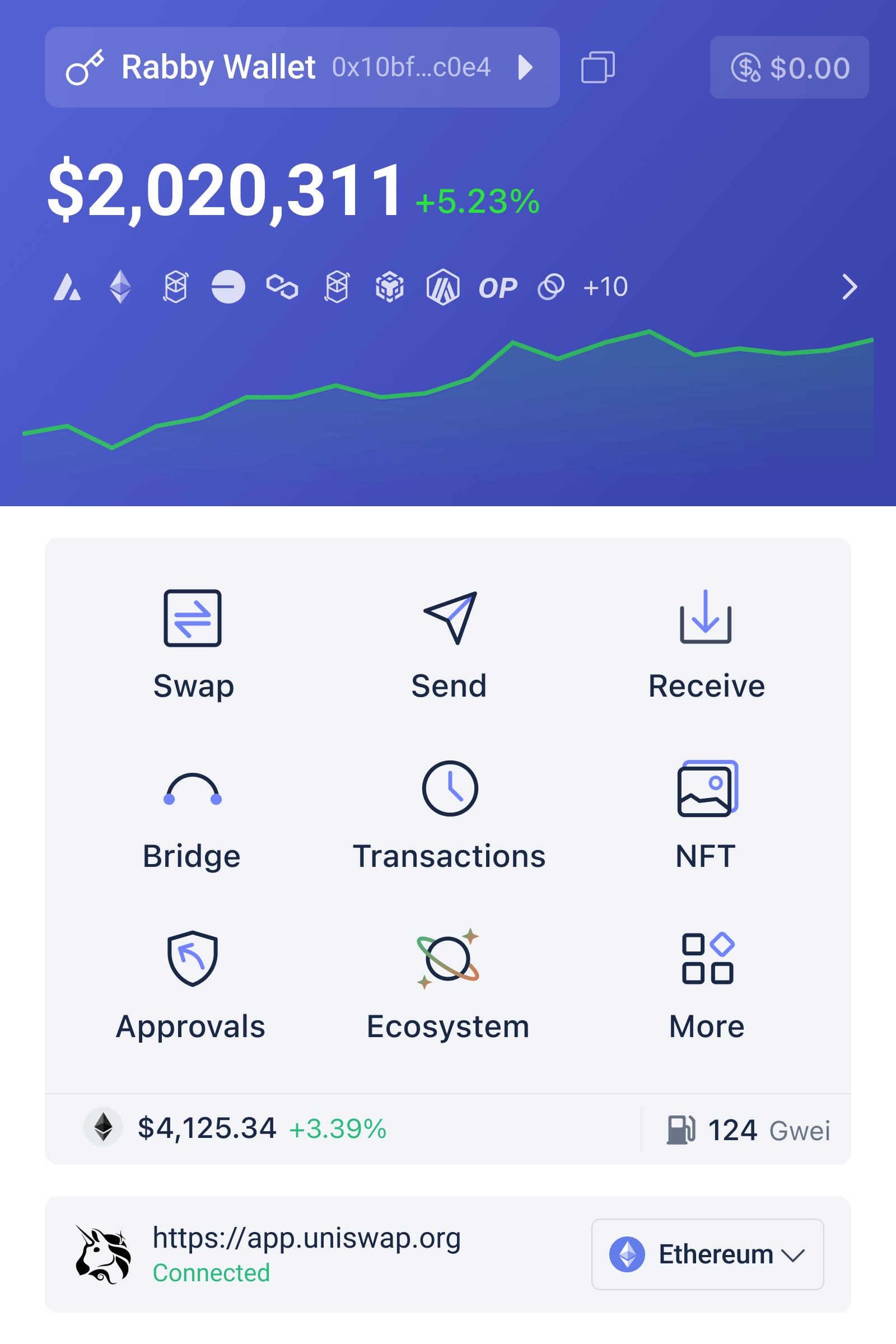
From a Wallet for Keys to a Wallet for Decisions
A useful mental model is to distinguish three functions that are often placed under the single word “wallet”. First, custody concerns where the private keys are stored and who can use them. Rabby is non-custodial: the keys remain locally on the user’s device rather than being transmitted to Rabby’s servers. Second, execution concerns how a signed message reaches a blockchain. Third, interpretation concerns what the requested action is likely to do. Rabby primarily adds value in this third layer, without taking custody of the user’s funds.
That distinction matters because a wallet does not normally decide whether a transaction is economically sensible. It receives a request from a decentralised application, displays information, and asks the user to sign. Rabby’s simulation changes the display from a largely technical request into a forecast of state changes: which assets may leave, which may arrive, and what approvals or contract effects are expected. For a user comparing a swap on Ethereum with one on Arbitrum, this is more informative than reading hexadecimal calldata or relying on a familiar protocol logo.
Yet a simulation is a model of a transaction under particular blockchain conditions, not a legal or financial guarantee. Its result depends on the available network data, the contract’s current state, and the assumptions used by the simulation service. A transaction can fail after conditions change, or a contract can behave in a way that is difficult to represent in a user interface. The correct interpretation is therefore “this is what the wallet currently expects,” not “this outcome is assured.”
For users looking to install Rabby, the security lesson begins before the installation itself. Downloading a browser extension from an impersonating page can defeat later safeguards. The same is true of entering a seed phrase into a website that claims to be a recovery tool. The official distribution channel, the extension’s permissions, and the device’s own security posture remain part of the threat model. A well-designed wallet cannot protect keys that a user has already disclosed to an attacker.
Why Multi-Chain Convenience Is Also a Risk Surface
Rabby supports more than 140 EVM-compatible networks, including Ethereum, Polygon, Arbitrum, Optimism, Avalanche, Base, and BNB Chain. EVM compatibility means that these networks share important technical conventions, allowing similar applications and wallet interactions across chains. Automatic network switching can remove a common source of operational error: manually selecting a chain that does not match the dApp’s request.
Convenience, however, can hide a different class of mistake. A user may approve a transaction on a legitimate application while looking at the wrong chain, the wrong token contract, or an asset with a similar symbol. A bridge adds further dependencies: the source chain, destination chain, bridge infrastructure, liquidity route, and sometimes a separate settlement process all matter. Integrating bridge protocols such as LI.FI can make cross-chain movement easier to access, but it does not eliminate bridge risk, liquidity constraints, smart-contract exposure, or the possibility of receiving a representation of an asset rather than the asset the user expected.
This is the central trade-off in multi-chain wallet design. Reducing friction may reduce simple configuration errors, yet friction also forces attention. Automatic switching is useful when it prevents a failed transaction; it is dangerous when it encourages users to treat chain identity as a background detail. A disciplined user should still confirm the network, contract address, asset denomination, recipient, and expected final balance before signing—especially when moving significant value.
The same principle applies to the integrated swap function. An aggregator can compare routes from decentralised exchanges such as Uniswap and 1inch, potentially improving price discovery and reducing manual searching. But “best rate” is not identical to “best transaction”. Slippage, price impact, route complexity, approval requirements, execution failure, and the trust assumptions of each contract can matter more than the quoted output. The wallet can expose these factors more clearly; it cannot make them disappear.
Custody, Open Source, and the Limits of Trust
Local key storage is a meaningful boundary: Rabby’s servers do not hold the user’s private keys. This reduces dependence on a central custodian and means that users retain responsibility for backups, device security, and transaction approval. It also means that losing the recovery material can be more final than losing access to a conventional online account. Non-custodial does not mean risk-free; it means the location of responsibility changes.
Rabby’s open-source architecture, released under the MIT licence, permits community inspection of the software. That is valuable because independent review can reveal implementation problems and make the code’s behaviour more accountable. Open source is not, however, the same as a permanent security certificate. Users may not be able to verify that the installed extension corresponds to the reviewed source, and dependencies, release processes, browser environments, and external services still matter. The appropriate conclusion is stronger transparency, not automatic trust.
Hardware-wallet compatibility with Ledger, Trezor, and OneKey creates another useful separation. The signing key can remain on a dedicated device while Rabby provides the interface and transaction context. This can reduce the impact of malware that attempts to extract private keys. It does not prevent a user from approving a malicious transaction on the hardware device. Hardware signing protects the secret; it does not independently establish that the human-readable intent is legitimate.
For a German DeFi user, this layered view is practical. A sensible setup might use a browser extension for a limited operating balance, a hardware wallet for longer-term holdings, and separate accounts for experimentation and savings. The objective is not to find one perfect security feature. It is to prevent a single compromised dApp, browser session, or rushed approval from exposing every asset at once.
Gas Accounts and Incentives: Helpful Features That Need Discipline
Rabby’s Gas Account allows network fees to be paid with stablecoins such as USDC, including situations where the user lacks the native token of a chain. This addresses a real usability problem: assets can be present on a network while a transaction cannot be submitted because the wallet has no ETH, MATIC, or other native gas asset. For occasional users, removing that obstacle may prevent unnecessary transfers between exchanges and networks.
But fee abstraction can weaken a useful warning signal. Having to obtain a chain’s native token reminds users which network they are using and creates a natural pause before signing. Paying fees in a stablecoin is operationally simpler, yet it makes it even more important to inspect the network and transaction outcome. Costs also remain costs; a different payment mechanism does not remove congestion, execution risk, or the economic effect of small repeated transactions.
The same caution applies to Rabby Points, which can be earned through activities such as swaps, gas top-ups, and referrals. A loyalty mechanism may encourage exploration, but incentives can also encourage unnecessary activity. Points should never be treated as compensation for smart-contract risk, nor as evidence that a transaction is financially attractive. A useful rule is simple: if the action would not make sense without the reward, its risk-adjusted value deserves particular scrutiny.
A Reusable Transaction-Review Framework
Before signing, users can apply a four-part check. First, verify identity: is the dApp domain correct, and is the contract address one you independently recognise? Second, verify intent: does the simulation show the token movement you expected, or is there an unfamiliar approval, recipient, or asset? Third, verify scope: is an approval limited to the amount and duration needed, or does it allow broad future spending? Fourth, verify reversibility: can the action be undone, or would a bridge transfer, liquidity position, or token approval leave you dependent on another contract?
This framework is deliberately stricter than merely looking for a green warning indicator. Security scanners are strongest against known patterns and known addresses. They are less reliable against newly deployed contracts, compromised front ends, economic exploits, or legitimate contracts used in an unsuitable way. The absence of a warning is therefore evidence of no detected signal, not proof of safety.
Recent project messaging presents Rabby as a broad Ethereum and EVM wallet for Chrome and other browsers, with desktop and mobile availability. If multi-chain applications continue to expand, wallets that combine network management with transaction interpretation may become increasingly important. The conditional implication is clear: as the number of chains and protocols grows, a wallet that reduces cognitive load could improve safety—provided users continue to treat simulations as evidence to evaluate rather than instructions to obey.
Frequently Asked Questions
Is Rabby safer than MetaMask by default?
It is designed as an alternative with a strong focus on multi-chain usability, transaction simulation, and security warnings. Those features can make risks more visible, especially for DeFi interactions. They do not make the wallet inherently immune to phishing, malicious contracts, compromised devices, poor backups, or careless approvals. Safety depends on the whole operating process, not only on the wallet brand.
What should I look at in a Rabby transaction simulation?
Check whether the expected token outflows, inflows, recipient, network, and approval scope match your intention. Treat unfamiliar assets, unlimited approvals, unexpected contract calls, and unexplained balance changes as reasons to stop. If you want to explore the product’s installation and wallet workflow, the rabby wallet resource can serve as a starting point, but always confirm that you are using an authentic distribution channel.
Does a hardware wallet remove the need to review transactions?
No. A hardware wallet helps keep private keys isolated and can reduce key-extraction risk. It does not determine whether a contract interaction is fraudulent or economically harmful. Review the transaction in Rabby and on the hardware device, and maintain separate accounts for different levels of risk.
The most defensible way to assess a multi-chain wallet is not to ask whether it can make DeFi safe. It cannot. The better question is whether it helps a user notice the difference between what an application claims and what a signed transaction is expected to do. Rabby’s simulations, warnings, network support, and hardware integrations can strengthen that verification step. Their value is greatest when they are used to slow down consequential decisions—not when they are used as a substitute for making them.
Deja una respuesta